Antalya
Antalya and the old town of Kaleiçi
Most people pass through Antalya on the way to somewhere else, which is a shame and also fair. The old town earns a night or two; the museum out west earns more time than almost anyone gives it.
Here is the honest shape of Antalya: a big, sprawling Mediterranean city of over a million people, with an old walled quarter the size of a few postcards stitched onto its seafront. That quarter is Kaleiçi, and it's the bit you came for. The rest is apartment blocks, ring roads and a tram line — useful, not romantic. So when someone says they "did Antalya in a day," they mean they walked Kaleiçi in an afternoon and sat by the harbour with a beer. You can do exactly that. Whether you should give it longer hinges on one building out west.
Start at the gate.
The marble gate everyone walks straight through
Hadrian's Gate — Üçkapılar to locals, "the three gates" — is the front door to the old town and the best-preserved Roman thing in the city. It went up around 130 AD for the emperor's visit: three matching marble arches between four columns, the only surviving gate from the old walls. The detail repays a slow look, with carved rosettes still on the coffered undersides and the original Roman road surface dipping below the modern street, rutted by carts you'll never see.
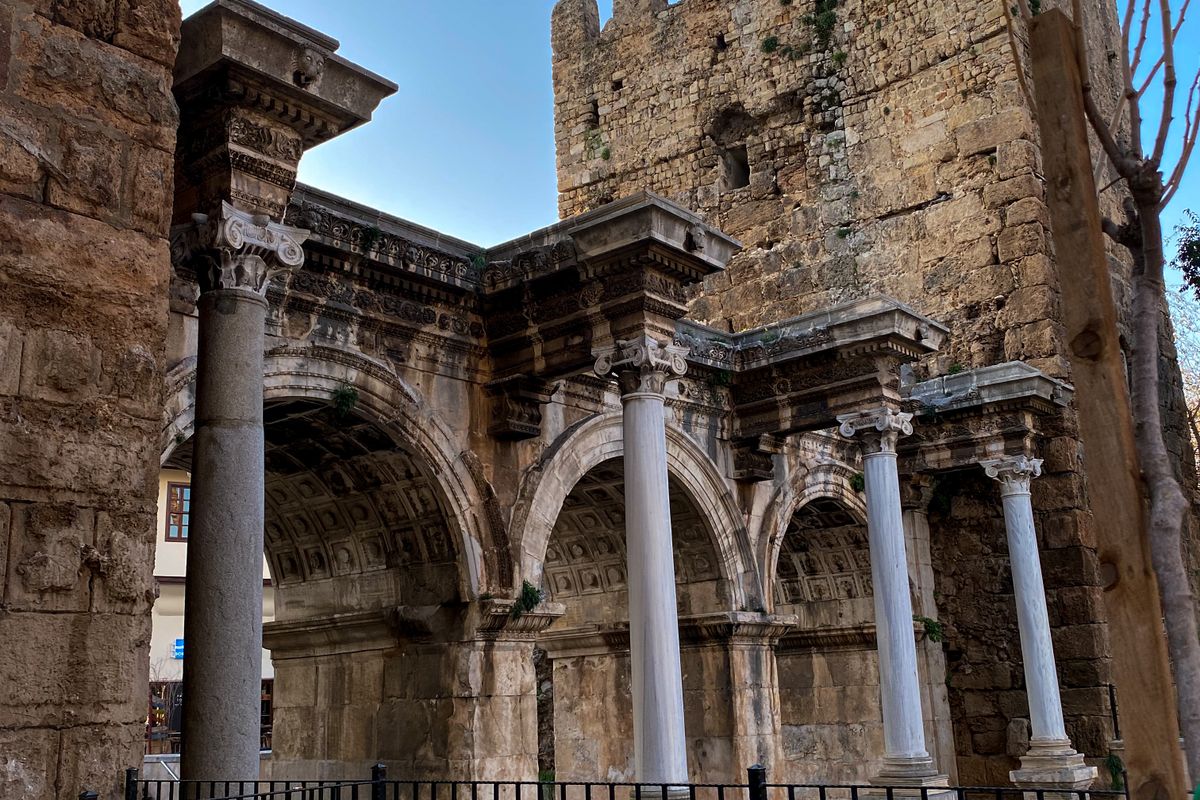
The catch is that almost nobody stops. It sits on a busy thoroughfare and crowds pour through toward the shops, so you get a few seconds of "oh, nice arch" before the current carries you off. Come back at eight, before the tour groups land, and you'll have it to yourself. Worth the alarm.
The fluted minaret that became the city's signature
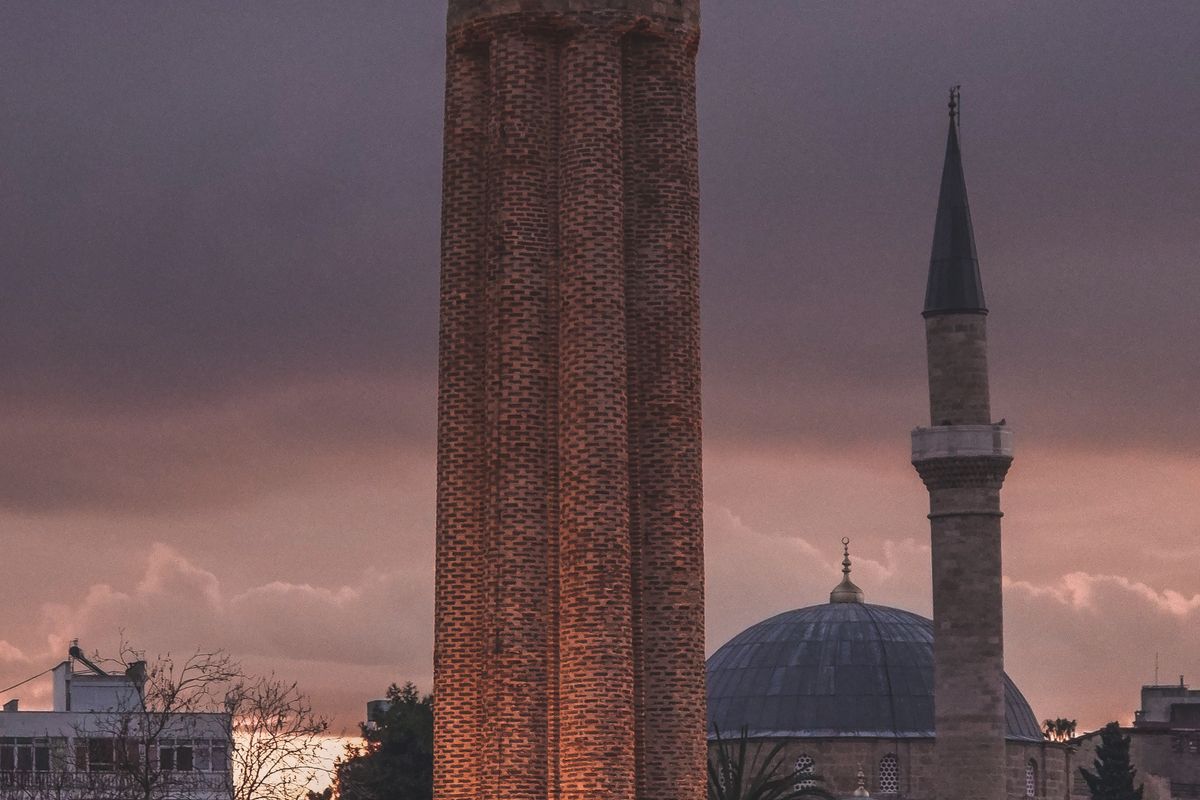
A few minutes north, the skyline gives you the Yivli Minare — the fluted minaret, the thing on every Antalya fridge magnet and, apparently, the local football badge. It's a 38-metre column of red brick on a square stone base, its half-round flutes catching the light, with a band of dark turquoise tiles near the top. The Seljuks built it around 1230, reusing the stones of an earlier church — the kind of recycling this whole coast does without comment. It photographs better than it visits; the mosque beside it is small and often busy with worshippers, so admire it from the square or go in quietly.
The lanes, the timber houses and the hard sell
The old town below the minaret is a knot of narrow streets you're meant to get pleasantly lost in. The houses are the point: tall Ottoman places of stone and timber, with overhanging upper floors that lean toward each other across the lane, carved doors and shuttered windows. Many are now small hotels, and that, oddly, is what kept them standing — boutique money restored façades that would otherwise have rotted.
Then there's the selling. The lanes nearest the gate and the harbour are thick with carpet shops, leather shops and restaurant touts, and a few push hard. None of it is dangerous, just relentless, and the "where are you from, my friend, looking is free" routine gets old by the third doorway. A friendly "no thanks" without breaking stride works. Don't feel you've been rude.
Note
If you want a carpet, buy it because you like it, not because of a story about a village co-operative. Prices are negotiable and the first number is theatre. And the "antique" coins, "Byzantine" lamps and "ancient" oil flasks in the tourist lanes are, with vanishing few exceptions, made last year.
Down to the old harbour
Keep heading downhill and the lanes deliver you to the harbour — a small curved Roman-era port tucked under the cliffs, maybe a hundred metres across, that did the city's heavy lifting for two thousand years and now does tourist boats and sunset dinners. It's undeniably pretty, and it's also where the restaurant mark-ups live, so eat with your eyes open.
- The view is free. Walk the quay, watch the boats, then climb back up to eat where locals do rather than at the first table with a laminated menu in six languages.
- Boat trips leave from here. Short hops along the cliffs and the Düden waterfall that drops straight into the sea — pleasant on a hot afternoon, skippable if you're short on time.
- Sunset is the move. Head for the cliff-top terraces near the Hıdırlık Tower instead of paying harbour prices for the same sun.
That tower — the Hıdırlık — sits where the cliffs meet the park at the southern edge of the old town: a stubby round Roman structure, second century, possibly a tomb, possibly a lighthouse, nobody's quite sure. You can't go in, but the terraces around it are the best free sunset seats in the city, and at golden hour half of Antalya is up there with a tea glass.
The broken minaret and the layers underneath
Back in the lanes, look for the Kesik Minare — the "broken minaret" — a stump of tower over a roofless ruin that is, quietly, the most interesting building in Kaleiçi. The shell underneath has been, in order, a second-century Roman temple, a Byzantine church, a mosque, a church again, and a mosque again, before fire took the top off the minaret. Fifteen-odd centuries of the same spot rebuilt for whichever god was in charge. No ticket booth, not much signage; it rewards standing still and reading the stones.
Kaleiçi is touristy — there is no honest way around that — but it is touristy in the way an old port is, with real walls and real arches under the gift shops, not a theme-park version of itself. A night or two here is time well spent. A week would be a stretch.
Which brings up the question of how long to stay, and the answer hinges on the one thing in town most visitors skip.
The museum nobody books enough time for
A couple of kilometres west of the old town, out past Konyaaltı, sits the Antalya Museum — the underrated highlight of the whole city. The Roman sculpture hall is the reason: rank after rank of marble emperors, empresses and gods lifted from the ruins of Perge up the road, many astonishingly intact. Plancia Magna, the noblewoman who paid for half of Perge, stands in the middle, alongside the Three Graces, a dancer caught mid-step, satyrs, and the Pamphylian and Lycian finds that tie the museum to the ancient cities along this coast.
What the room does that a ruin can't is give you the people who lived there — faces, drapery, the actual statues that stood in the streets you'll walk at Perge. So pair them on the same trip, in either order, and each makes more sense of the other. The city tram runs out this way to both the museum and the long sweep of Konyaaltı beach. There's more on the run in from the plane in our notes on Antalya Airport and the coast, and on the sand in the city beaches.
Practicalities, briefly
Kaleiçi is small and entirely walkable — leave the car outside the walls, since the lanes are barely scooter-width; there's paid parking near the gate. The Antray tram links the old town to the museum and Konyaaltı one way and the long-distance bus station the other, cheap and card-only, and it beats a taxi for the museum run. Mornings here are calm and cool; by mid-afternoon in summer it's hot, crowded and loud, so do your monument-looking early and save the harbour and cliff terraces for the evening.
Most people, in the end, use Antalya as a hinge rather than a destination — a base, a gateway to the resorts and the ruins inland. That's fine; just don't let the through-traffic mindset make you skip the gate at dawn or the museum out west. For the wider region, the Lonely Planet overview and the national tourism board pages are reasonable starting points, and the UNESCO listing for the Yivli minaret complex is worth a glance before you stand under it.