Antalya · Practical
Antalya Airport and the run down the coast
The airport is the easy part; your Antalya airport transfer is the part worth getting right. Where you end up — central Antalya, Belek, Side, Kemer, Alanya — decides whether you want a 27-lira tram ticket or a car waiting at arrivals. Here is how each option actually works.
Antalya Airport (code AYT) sits about 13 km east of the city, close enough that a flight landing at dusk still gets you to dinner in the old town. It is one of the busiest holiday airports in Europe, and in July and August it shows: the international halls move through hundreds of charter flights a week, and the taxi rank can have a forty-minute queue while a hundred hotel-transfer drivers hold up name boards a few metres away.
Your first decision is made before you land, really, by where you booked. If you are staying in or near central Antalya, public transport is genuinely good and cheap. If you are staying anywhere along the resort belt — Belek, Side, Kemer, Alanya — you are looking at a longer drive, and the sensible options narrow to a car.
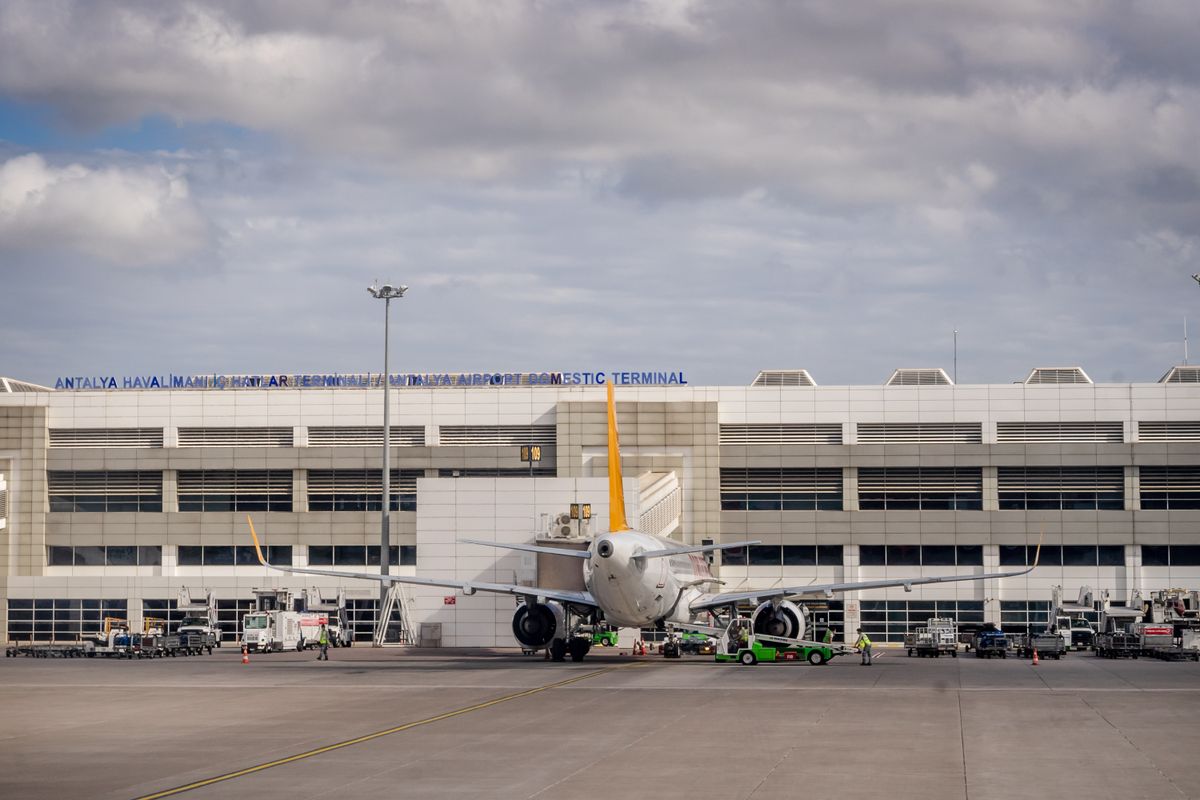
First, work out which terminal you flew into
This trips people up more than it should. There are two international terminals — Terminal 1 and Terminal 2 — plus a separate domestic terminal, and they are not in the same building. Terminal 1 and Terminal 2 sit side by side; the domestic terminal is roughly 2.5 km away. If a friend is collecting you, agree the exact terminal in advance, because "I'm at Antalya Airport" can mean a long walk or a shuttle ride apart.
Inside arrivals you will find ATMs, a few car-hire desks, and counters selling Turkish SIM cards. The SIMs at the airport are convenient but priced for arrivals; if you can wait until town you will pay noticeably less. Pull some lira from an ATM rather than changing cash at the desks — the rates are friendlier, and you will want small notes for the tram or a kiosk.
The AntRay tram — the cheap way into the city
If you are heading for central Antalya or Kaleiçi, the AntRay tram is the one to know about. The line runs from a stop right by the terminals into the centre in roughly 30 to 40 minutes, depending on your stop, with trams every 10 to 20 minutes from around 6 a.m. to midnight.
One catch is the ticket. You cannot pay the driver in cash — you need an Antalyakart, the city's rechargeable transport card, which you buy and top up from a machine near the stop. The card itself runs about ₺50, and a single ride is roughly ₺27 (around €0.70) and stays valid for 60 minutes, so a transfer onto a connecting tram or city bus is free within that window. For two people with light bags going to a hotel near the old town, it is hard to beat.
Note
The AntRay light rail is not the little vintage tram you will see rattling along the seafront near Kaleiçi — that is the nostalgic tramway, a short heritage line, not airport transport. Two different trams, easily confused on a tired arrival day.
Buses and the airport shuttle
Two public bus lines leave from in front of the terminals. Line 600 mostly does the useful job of linking the international and domestic terminals every half hour or so. Line 800 runs out to Lara Beach and Konyaaltı, Antalya's two main beach strips, roughly every two hours, taking around 50 minutes end to end — cheap, but the gaps between buses make it a gamble with a flight time.
There is also a HavaŞ airport shuttle, the coach-style service you find at most Turkish airports, departing hourly through the day from outside the terminals. It is comfortable and priced around ₺160 (roughly €4) per seat. For a solo traveller with a big suitcase who does not fancy hauling it onto a tram, it is a fair middle option into the centre. The list, shortest to longest:
- AntRay tram — cheapest, frequent, but only useful if your hotel is near the line.
- Bus 800 — reaches the beaches directly, but the two-hour frequency is unforgiving.
- HavaŞ shuttle — fixed seat, room for luggage, hourly.
- Taxi or a booked car — door to door, the only realistic choice for the far resorts.
Taxis from the rank
Taxis are metered and queue at a marked rank outside arrivals. A ride into central Antalya is short and usually lands somewhere in the low tens of euros once you account for the meter and the airport supplement; out to the Lara hotels it is a touch more. Night runs (very roughly 10 p.m. to 6 a.m.) carry a higher tariff, often around 50% more.
Two honest cautions. First, insist the meter is running rather than agreeing a "special price" — the meter protects you. Second, the further your resort, the worse value a metered taxi becomes against a pre-agreed fare, because a long meter to Side or Alanya can climb past what a booked car would have cost you flat. For a hop into the city, though, a taxi is quick and fine.
The resort belt — why most people arrive in a booked car
Here is the thing the brochures gloss over: Antalya's "airport" serves a coastline that stretches for well over a hundred kilometres, and the resorts are not close. A car waiting at arrivals — an Antalya airport transfer arranged in advance, with a driver holding your name at the barrier — is the default for the resort belt for a simple reason. The drive is long enough that you do not want to be solving it at 2 a.m. with a screaming toddler and three cases.
The distances, very roughly, from AYT:
| Where you are going | Rough distance | Drive time | Sensible choice |
|---|---|---|---|
| Lara / Kundu | ~10–15 km | 15–20 min | Taxi or booked car |
| Central Antalya / Kaleiçi | ~13 km | ~30 min | AntRay tram, shuttle or taxi |
| Belek | ~35 km | ~40 min | Booked car |
| Side | ~65 km | ~1 hr | Booked car |
| Kemer | ~55 km | ~1 hr | Booked car |
| Alanya | ~125 km | 2–2.5 hr | Booked car |
So a private car from Antalya airport to Side takes about an hour, Kemer about the same heading the other way, and Alanya is a proper two-hour-plus haul east along the D-400. Belek, the golf belt, is the closest of the big resort names at around 40 minutes. If your hotel offers a transfer, it is usually a smoother arrival than wrangling a public bus with the whole family's luggage.
If you booked a package, check the small print before you book anything separately — operators very often bundle the airport transfer in, or sell it cheaply alongside the room. People pay twice all the time.
That bears repeating because it is the most common money mistake here. A large share of summer visitors land already covered: the tour operator's rep is in the hall, the coach is in the car park, and the whole thing is on the confirmation email under a line nobody read. Dig it out before you arrange a car of your own.
One catch for the far west
If your sights are set on Kaş or Kalkan, out in the quieter southwest, note that they are 3-plus hours from Antalya by road and frequently closer to Dalaman airport instead. It is worth pricing flights into both before you book — landing at the nearer airport can save you half a day each way. For the headline resorts east of the city, though, AYT is the one you want.
Once you are off the plane and rolling, the rest of the coast is straightforward. Our guide to getting around the Turquoise Coast covers the dolmuş minibuses, intercity coaches and car hire between towns, and if Antalya itself is your base, the walk-through of Antalya and the old town of Kaleiçi picks up where the tram drops you. Land, sort the first ride, and let the coast do the rest.
Two practical reads before you fly: the airport's own passenger information pages for live terminal and arrivals detail, and the city transport authority's Antalyakart site for current tram fares and where to buy the card. For shuttle timetables and seat prices the HavaŞ network publishes its Antalya departures. Prices drift, so treat every figure here as a guide and confirm the ones a long day depends on.