Beaches
Kaputaş, Patara and the coast's best beaches
The two finest beaches on this coast sit at opposite ends of the same idea. One is a pocket cove of impossible colour; the other is a wild, eighteen-kilometre sweep of dunes beside a dead Lycian city. Both are out west, both are worth the drive, and here is how to read them.
Let's be honest about geography first. When people picture the Turkish Riviera they think of Antalya, and most never get further than the city's own pebble strands. The beaches that end up on the postcards are a good three hours west of the airport, out in the Lycian stretch between Kaş and Kalkan — closer to those towns than to Antalya. From the city these are a full day out, not an afternoon. We think they're worth it, and we'll tell you which one we'd choose if we only had time for one.
This is a two-beach story, with a couple of footnotes.
Kaputaş: the cove that broke the internet
You've seen it whether you know the name or not. A small triangle of pale sand at the bottom of a deep gorge, water the colour of a swimming pool someone left on, sheer rock on three sides. Kaputaş is the one photographed from the bridge above, drone hovering, everyone pretending they discovered it.
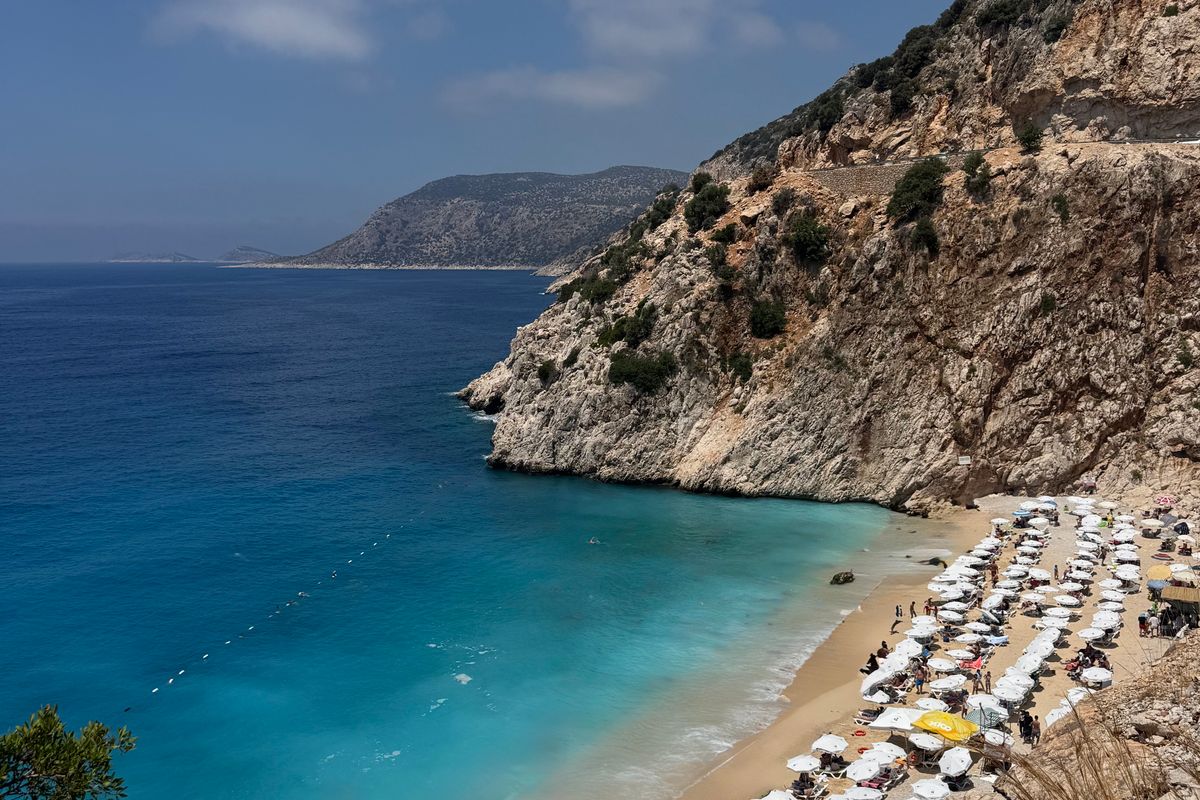
It sits right on the Kaş–Kalkan coast road, the D400, where the highway crosses the mouth of a narrow canyon on a small bridge. From the layby you look straight down onto it — the famous view. To actually swim, you walk down a long flight of steps cut into the cliff: somewhere around 180 of them, depending on who's counting and how tired you are coming back up. The water is genuinely cold, fed partly by spring water draining out of the gorge, and that mix is a big part of why it reads as electric turquoise rather than ordinary blue.
Now the honest part. It's small, and it has almost no natural shade. By late morning in summer the whole cove is in full sun and packed shoulder to shoulder, a row of rented sunbeds eating most of the sand. Still beautiful — just beautiful with three hundred other people. The trick is timing.
Go early or go late. Before about ten in the morning the steps are quiet, the loungers aren't all out yet, and you get the cove closer to the version in the photographs. The hour before sunset works too, when the day-trip buses have left. Midday in July is the one time we would genuinely tell you not to bother.
Bring water and something to sit on; you won't always get a free patch of sand otherwise. There's a small snack kiosk by the steps but don't plan a meal around it. And mind your footing on the way down — the steps are steep, occasionally wet near the bottom, and flip-flops have ended more than one holiday with a sprained ankle.
Patara: eighteen kilometres of wild
If Kaputaş is the photograph, Patara is the antidote. Drive twenty minutes west and you reach the opposite kind of beach: an unbroken sweep of fine golden sand running something like eighteen kilometres, backed not by hotels but by rolling dunes and, behind those, the ruins of an entire ancient city.
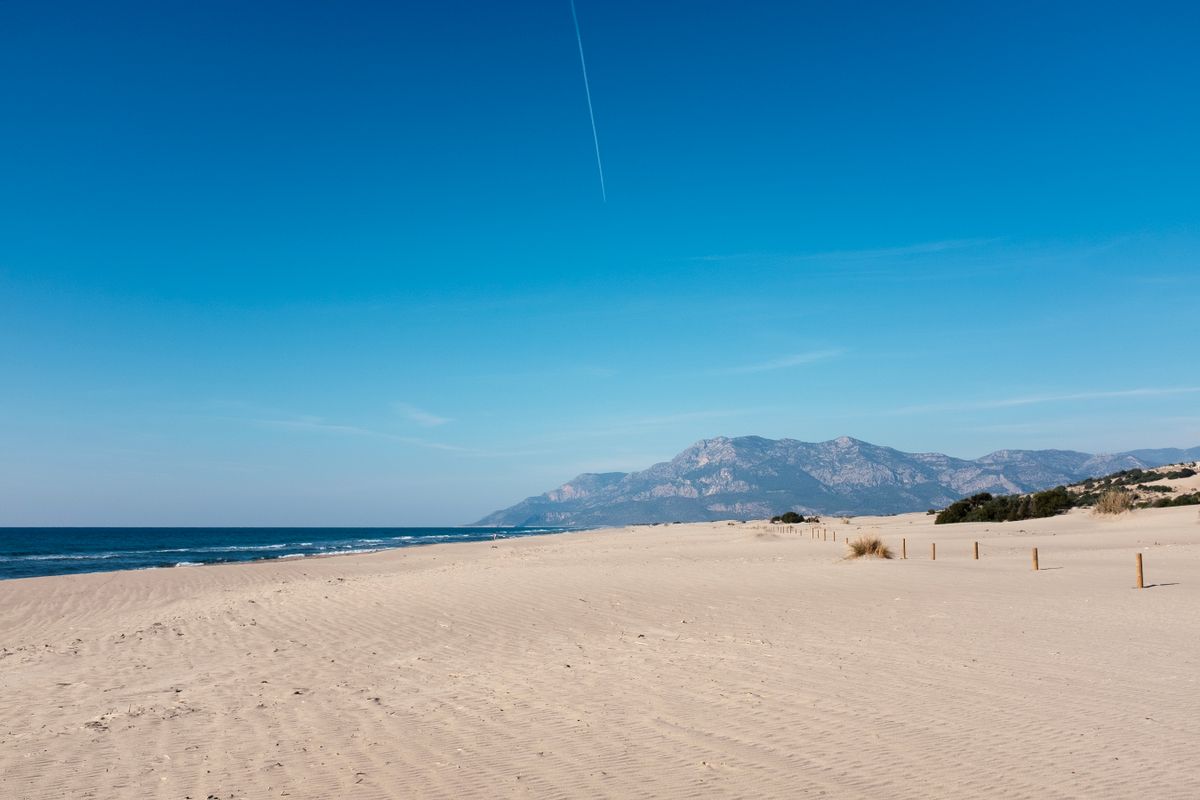
Patara is wild on purpose. It's a protected nesting ground for the endangered loggerhead sea turtle — Caretta caretta — and that status is the reason it has never been built on. No resort strip, no beach clubs, no concrete. Just sand, dunes, the wind sculpting ripples into it, and the sea. Because of the turtles the beach closes in the evening through nesting season, usually from around eight at night, so the females can come ashore and lay undisturbed. You won't be on it at midnight, and that's exactly why it stays the way it is.
The other half of Patara is the ruins, and you reach the beach by driving straight through them. This was no minor place: one of the great cities of ancient Lycia, the federation's effective capital and a port that mattered across the eastern Mediterranean, holding the maximum three votes in the Lycian League. It's also, by tradition, the birthplace of the man who became Saint Nicholas. The site today is genuinely good — a Roman theatre, a colonnaded main street, a triple-arched gate, the council house where the league met. You can read the long version on the Patara entry on Wikipedia if the history grabs you.
Patara is the rare beach where you can swim in the morning, walk a Roman main street in the afternoon, and not see a single hotel from the sand. There is nowhere else on this coast quite like it.
Practically: budget half a day, not an hour. The same ticket usually covers ruins and beach, the dunes get hot enough to need shoes by midday, and the only shade on the sand is a small cluster of rented umbrellas near the boardwalk. Everything past that you provide yourself, and there's very little to buy once you're out there — take more water than you think.
The ones in between, briefly
Kaputaş and Patara are the headliners, but this stretch of coast is full of smaller swimming spots you'll pass between the two.
- The bays around Kaş. Kaş isn't really a sand-beach town — it's rock platforms, ladders into deep clear water, and a few small pebble coves reached on foot or by boat. Büyük Çakıl, a short walk from the centre, is the easy one. More on the town in our guide to Kaş and Kalkan.
- Kalkan's beach clubs. Kalkan has almost no public beach, so the swimming culture there is built around platform clubs lining the bay — pay for a sunbed, get a ladder into the water and a waiter for the day. Less wild, more comfortable, and not a bad way to spend an afternoon once the steps and dunes have worn you out.
Coming from the Antalya side and want the city's own easier sand first? That's a different chapter — our notes on Konyaaltı, Lara and the city beaches cover the ones you can reach without leaving town.
How to actually do both
The blunt truth is that you need a car, or a tour, for this part of the coast. Minibuses — the dolmuş — run the Kaş–Kalkan road and will drop you at the top of the Kaputaş steps, cheap and frequent in season. Patara is harder by public transport: the bus leaves you at Patara village, a couple of kilometres short, with ruins and sand still ahead. Doable, but it eats your day.
With your own wheels the loop is simple. Hit Kaputaş early, before the crowds and the heat; drive west to Patara, do the ruins while the light is still kind, then the beach. If you're starting from Antalya, sort a rental or pre-book a private transfer first, because the distance is real and the last thing you want after the dunes is an unplanned three-hour drive. Turkey's official tourism board has a solid overview of Patara with current opening details, and the cove's practicalities are worth skimming on recent visitor reviews of Kaputaş before you commit to a midday arrival.
So which one?
One day, one choice — here's ours, plainly.
Go to Kaputaş for the photograph and a cold, bracing swim — half an hour of jaw-drop, ideally first thing, then move on before it fills. But give Patara the bulk of your time. The space, the dunes, the empty kilometres, the ruins behind the sand, the relief of a beach nobody was allowed to ruin — that's the one you'll still be talking about months later. Kaputaş is the prettier picture. Patara is the better day, and we'd argue the best beach on the whole coast, if you're willing to make the journey west to find it.